Perimenopause and Emotional Wellbeing: Why You May Not Feel Quite Like Yourself

Perimenopause is more than a change in your menstrual cycle. It can influence how you feel, think, sleep and function, too.
There is a version of perimenopause we have traditionally been taught to expect: periods become irregular, perhaps hot flushes appear, and eventually menstruation stops.
But for many women, the experience is broader than that.
You may feel more irritable than usual. Stress may seem harder to manage. Your concentration may not feel as reliable. You might lose your train of thought, wake during the night and struggle to get back to sleep, or feel more tired than you expect.
And perhaps the most unsettling part is simply feeling different from yourself.
These experiences can occur during perimenopause. As ovarian hormone levels fluctuate, they can interact with systems involved in mood, cognition, sleep and the body's response to stress. At the same time, life circumstances and individual factors can influence how strongly these changes are experienced.
Perimenopause is a transition, not simply a hormone decline
One of the most important things to understand about perimenopause is that hormones don't simply switch off.
During the transition, ovarian function becomes less predictable. Ovulation may occur less consistently, progesterone production can become more variable, and oestrogen levels can fluctuate considerably before eventually declining around menopause.
Those fluctuations matter because reproductive hormones interact with many systems throughout the body, including the brain.
This helps explain why perimenopause can be associated with changes in mood, sleep and cognition, as well as the physical symptoms more commonly associated with the transition.
But there is no single perimenopause experience.
Some women notice very little. Others experience significant changes. Previous mood disorders, sensitivity to hormonal change, sleep disruption, stress and psychosocial circumstances can all influence the experience.
The transition is biological, but the experience is individual.
When your mood feels different
Mood changes can be difficult to describe.
Perhaps you are more easily irritated. You feel more emotionally reactive or find yourself becoming tearful more readily. You may feel anxious, overwhelmed or less resilient than you were before.
For some women, there can also be a reduction in motivation or enjoyment.
Mood symptoms are recognised features of the menopause transition, and the risk of clinically significant depressive symptoms increases during perimenopause.
Importantly, this can happen even in women who have never previously experienced depression.
Hormonal fluctuations are thought to interact with brain systems involved in mood, while stress, sleep and life circumstances can further influence symptoms.
This can be particularly confusing when nothing obvious in your life seems to explain the change.
Your work may be the same. Your relationships may be good. Your responsibilities haven't suddenly increased.
And yet, you feel different.
That doesn't mean the experience is “all in your head”. It means there may be several interacting factors worth understanding.
Why stress can feel harder to manage
Cortisol often gets talked about as though it is something that needs to be reduced.
It doesn't.
Cortisol is an essential hormone involved in the body's response to stress, metabolism, immune function and the normal daily rhythm of alertness and activity.
The more useful question is not “How do I lower my cortisol?” but “How well is my stress-response system regulating itself?”
The sympathetic nervous system helps the body respond to challenge. The parasympathetic nervous system supports rest and recovery. Healthy regulation involves being able to move between these states appropriately.
During perimenopause, hormonal changes can interact with sleep, mood and the stress response. And this often occurs at a life stage when women may already be carrying substantial responsibilities.
Work. Relationships. Parenting. Caring for ageing parents. Financial pressures. The mental load of keeping everything moving.
So when stress feels harder to manage, it may not be one thing causing it.
It can be the interaction between hormonal change, sleep, stress and everything else your body and mind are carrying.
When your brain feels different
“Brain fog” has become one of the most recognisable phrases associated with perimenopause.
You know the word, but can't quite retrieve it.
You walk into a room and forget why.
You read something and realise you haven't absorbed it.
A task that once felt automatic suddenly requires much more concentration.
These experiences are common enough to be recognised as part of the menopause transition. Research suggests that some women experience subtle changes in aspects of memory and cognition during this period, although objective cognitive performance generally remains within expected ranges.
Importantly, cognitive symptoms don't necessarily have a single cause.
Hormonal changes may play a role, but sleep disruption, hot flushes, mood changes, stress and normal ageing can all contribute.
That distinction matters.
Brain fog can be real and disruptive without meaning that your brain is deteriorating.
For a woman accustomed to feeling mentally sharp and capable, however, even relatively subtle changes can affect confidence.
It's not only what you can remember. It's how you feel about your ability to rely on yourself.
The connection between sleep, energy and mood
Sleep is another important piece of the picture.
Perimenopause can be associated with sleep disruption, including difficulty falling asleep or waking during the night. Vasomotor symptoms such as night sweats can contribute, but sleep difficulties don't always have a single explanation. Stress, mood and other factors can play a role too.
And poor sleep can have consequences the following day.
You may feel more tired. Concentration can become harder. Emotional regulation can be more difficult. Everyday tasks can require more effort.
This creates a relationship between sleep, energy, mood and cognitive function.
Nutrition matters here, too. Eating a varied, balanced diet and maintaining adequate intake of key nutrients supports general health and wellbeing. For women experiencing significant fatigue, particularly alongside heavy menstrual bleeding, iron deficiency is also worth discussing with a healthcare professional rather than simply assuming the symptom is hormonal.
Sometimes what feels like one problem is actually several things interacting.
A more complete way to think about perimenopause
Perhaps the most useful shift is to stop looking at each symptom in isolation.
Mood can be affected by sleep.
Focus can be affected by stress.
Energy can be affected by sleep, nutrition and overall wellbeing.
And hormonal fluctuations can sit alongside all of them.
This doesn't mean every change you experience in your forties is caused by perimenopause. New, persistent or concerning symptoms deserve appropriate medical assessment.
But if you are experiencing changes in your mood, concentration, sleep or energy alongside other signs of hormonal transition, perimenopause deserves to be part of the conversation.
You don't need to wait until your periods stop. Perimenopause is the period leading up to menopause, and symptoms can begin while you are still menstruating.
Supporting yourself through perimenopause
There isn't one solution that needs to do everything.
The right approach depends on your symptoms, health history, preferences and circumstances.
For some women, menopausal hormone therapy may be appropriate. NICE recommends considering HRT for depressive symptoms that do not meet the criteria for depression when they begin around the same time as other menopause-associated symptoms.
Psychological support can also have an important role. Menopause-specific CBT is one evidence-based option for some menopause-associated symptoms, including depressive symptoms and sleep problems.
And the foundations still matter: regular movement, nourishing food, adequate sleep, stress management, connection and recovery all form part of supporting wellbeing through this transition.
For some women, targeted nutritional support may also have a place alongside these foundations.
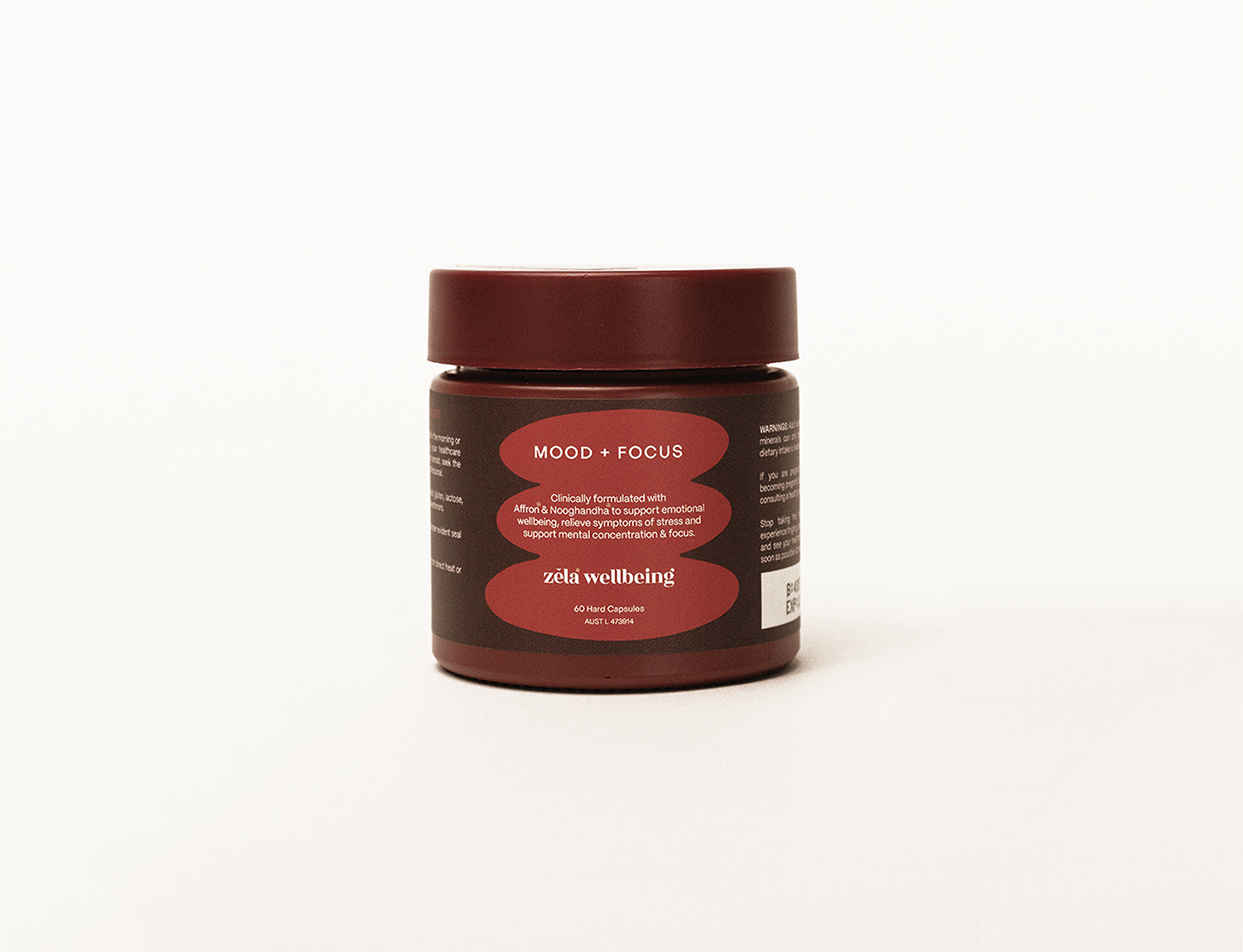
Mood+Focus is a doctor-formulated, multifunctional formula developed by women's health doctor Dr Fatima Khan, with TGA-listed indications to support emotional wellbeing and healthy mood balance, stress and mild anxiety, attention and mental concentration, energy and fatigue, as well as natural body cleansing processes and healthy thyroid function.
It is one part of a broader approach to supporting wellbeing during perimenopause.
You are not imagining the change
Perimenopause can be difficult precisely because so much of what changes is invisible.
You can still be doing your job, caring for the people you love, managing your responsibilities and appearing completely fine from the outside, while privately wondering why things suddenly feel harder.
Understanding the hormonal transition doesn't mean attributing everything to hormones.
It means having another piece of the puzzle.
So if you're noticing changes in your mood, stress levels, concentration, energy or sleep, it may be worth asking not “Why can't I cope like I used to?”, but: "What has changed, and what support do I need now?”
That can be a much more useful place to begin.

References:
Williams, M. & Maki, P. M. (2025). A review of cognitive, sleep, and mood changes in the menopausal transition: Beyond vasomotor symptoms. Obstetrics & Gynecology, 146(3), 350–359. https://doi.org/10.1097/AOG.0000000000005914
Zhu, C., Thomas, N., Arunogiri, S. & Gurvich, C. (2022). Systematic review and narrative synthesis of cognition in perimenopause: The role of risk factors and menopausal symptoms. Maturitas, 164, 76–86. https://doi.org/10.1016/j.maturitas.2022.06.010
Badawy, Y., Spector, A., Li, Z. & Desai, R. (2024). The risk of depression in the menopausal stages: A systematic review and meta-analysis. Journal of Affective Disorders, 359, 1–10. https://doi.org/10.1016/j.jad.2024.04.041