The Neuroscience of Focus: Why Concentration Changes During Perimenopause

Losing your train of thought mid-sentence. Reading a page and realising nothing went in. Needing to reread an email three times before it makes sense. Most women who experience this in their 40s describe it the same way: it feels like losing your edge.
It is not. There is a specific, well-documented reason focus and mental clarity change during perimenopause, and it has nothing to do with capability. It has to do with what fluctuating oestrogen is doing to the parts of the brain responsible for attention and memory.
The brain is an oestrogen-sensitive organ
Oestrogen receptors are densely expressed in the hippocampus and the prefrontal cortex — the two regions responsible for working memory, verbal memory retrieval and sustained attention. These are not peripheral effects. They are core to how oestrogen shapes brain function throughout a woman's reproductive life, not only during the transition out of it.
During perimenopause, the issue is rarely a simple decline. Oestrogen fluctuates, often sharply, from one cycle to the next. Because oestrogen's fluctuation is irregular rather than steady, its downstream effect on these circuits is irregular too — which may help explain why focus can feel sharp one week and unreliable the next, rather than gradually worse over time.
A measurable shift in how the brain uses fuel
Alongside the receptor effect, the perimenopausal transition is associated with a measurable shift in cerebral glucose metabolism — a change in how efficiently the brain uses glucose as fuel. In practical terms, this can mean tasks that once felt automatic now draw on more effortful, conscious processing. The brain is not doing less; in some respects, it is working harder to do the same job.
This pattern is transitional for most women. Verbal memory and processing speed are well-documented to recover once the transition completes — the underlying glucose metabolism shift is less clearly tracked long-term, and current research has not yet established whether it fully reverses or simply changes shape.
Why attention specifically feels harder to hold
Oestrogen does not act alone. It modulates serotonergic, noradrenergic and dopaminergic transmission — and dopaminergic circuits are central to sustained attention and working memory. When oestrogen signalling becomes inconsistent, so does its influence on these circuits, which may help explain why perimenopausal focus difficulty often shows up more as difficulty sustaining attention than difficulty encoding new information.
Sleep is the multiplier
Memory consolidation happens overnight. Perimenopause is frequently accompanied by sleep fragmentation — vasomotor symptoms and 2 to 4am waking are common drivers — and interrupted sleep compounds every hormonally-driven cognitive symptom on this list. A woman dealing with both fluctuating oestrogen and broken sleep is contending with two separate mechanisms working against her concentration at once, not one.
What the research actually shows
Longitudinal cohort data show verbal memory performance dipping during the perimenopausal transition and largely recovering as the transition completes. Importantly, objective cognitive testing during this period generally remains within expected ranges, even in women who report a noticeable, frustrating change in how their focus feels day to day.
That distinction matters. Subjectively, something has clearly changed. Objectively, this is a well-characterised, temporary feature of the transition — not evidence of cognitive decline.
When it is worth a closer look
Cognitive symptoms in perimenopause do not have a single cause. Sleep disruption, vasomotor symptoms, mood changes, iron deficiency and normal ageing can all contribute alongside hormonal fluctuation. If concentration difficulty is severe, rapidly worsening, or accompanied by other symptoms that concern you, it is worth raising with your doctor rather than attributing everything to perimenopause by default.
Supporting focus during this phase
Because attention span and mental concentration are so directly affected by this transition, this is one area where targeted nutritional support has a genuine, TGA-recognised role — rather than one we are stretching to fit.
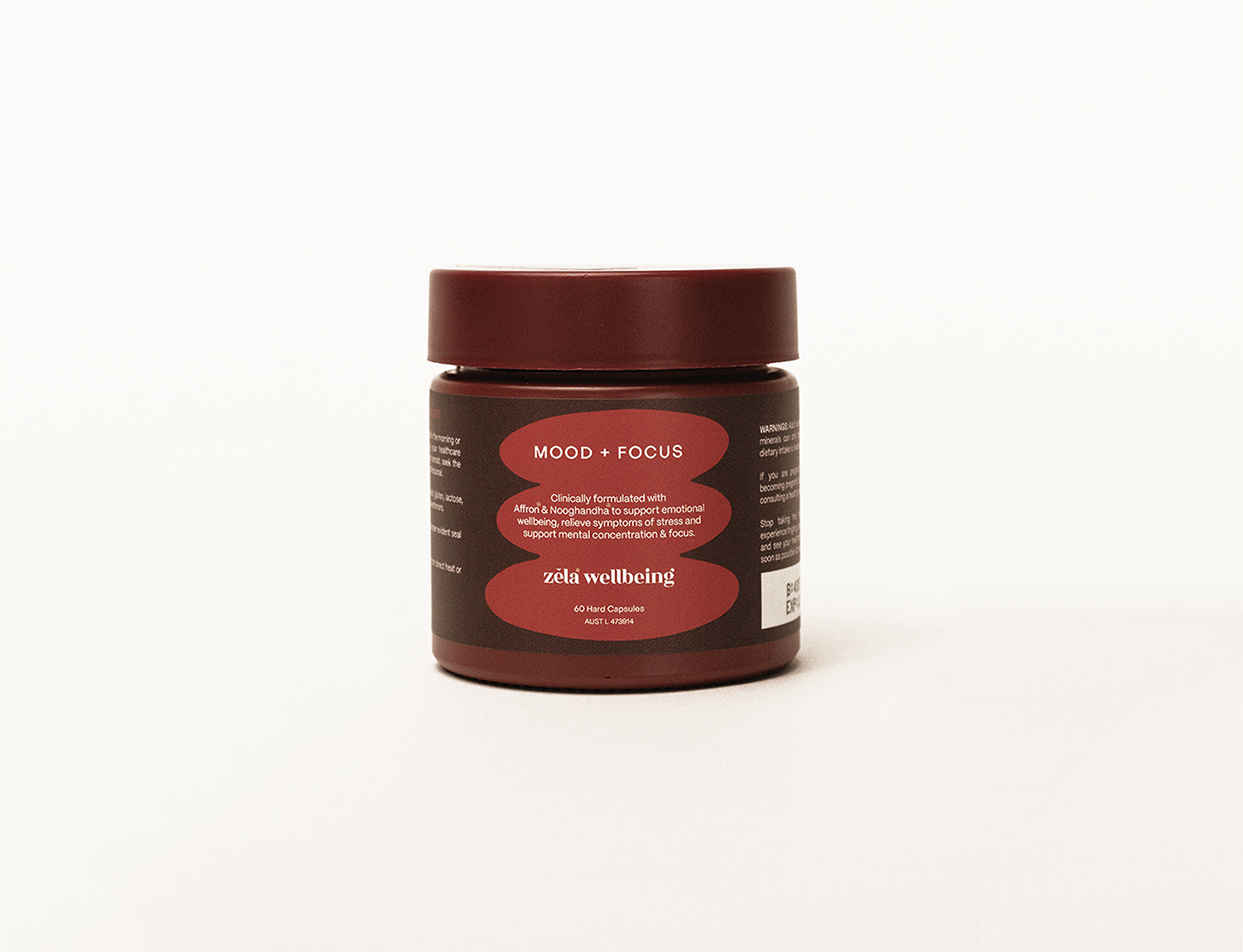
Mood+Focus is a doctor-formulated, multifunctional formula developed by women's health doctor Dr Fatima Khan, with TGA-listed indications to help increase attention span and mental focus, support healthy mood balance, and enhance energy levels and relieve fatigue.
It is one part of a broader approach to supporting focus and clarity during perimenopause — alongside protecting sleep, tracking whether symptoms are truly hormonal or have another driver, and seeking medical assessment where something feels genuinely wrong rather than simply different.

You have not lost your edge
Perimenopausal brain fog is real, it is physiological, and it is explainable at the level of receptors, neurotransmitters and brain energy metabolism. It is not a sign that you are declining. It is a sign that your brain is moving through a transition it will come out the other side of — and understanding the mechanism is often the first step in feeling less unsettled by it.
This content is general educational information and does not constitute medical advice. It cannot account for your individual history, and it is not a substitute for a consultation with your own doctor. If you have symptoms that concern you, please seek personal medical advice.
References
Greendale GA, Huang MH, Wight RG, Seeman T, Luetters C, Avis NE, Johnston J, Karlamangla AS. Effects of the menopause transition and hormone use on cognitive performance in midlife women. Neurology. 2009;72(21):1850–1857.
Mosconi L, Berti V, Guyara-Quinn C, McHugh P, Petrongolo G, Osorio RS, Connaughty C, Pupi A, Vallabhajosula S, Isaacson RS, de Leon MJ, Swerdlow RH, Brinton RD. Perimenopause and emergence of an Alzheimer's bioenergetic phenotype in brain and periphery. PLOS ONE. 2017;12(10):e0185926
Jacobs EG, D'Esposito M. Estrogen shapes dopamine-dependent cognitive processes: implications for women's health. Journal of Neuroscience. 2011;31(14):5286–5293.